


Having difficult conversations can be uncomfortable, emotional, and even confrontational. But what if you could learn how to have difficult conversations constructively and productively? It is possible to have difficult conversations while maintaining respect and empathy for each other. By approaching them thoughtfully, you can turn difficult conversations into opportunities for growth and stronger relationships.
ChoosingTherapy.com may earn a commission from the companies whose services are linked on this page.
Are communication issues hurting your relationship?
You can develop better communication skills and improve your relationship! OurRitual is a new, hybrid approach to couples therapy that includes weekly expert sessions in addition to self-guided work. OurRitual starts at just $36 per week. Get 20% off your first month with code: choosingtherapy20
When Is Having a Difficult Conversation Important?
When there is a problem, conflict, or misunderstanding between two or more people, the best way to resolve it is by having a conversation instead of engaging in avoidance behaviors. By doing so, you are dealing with your emotions instead of hiding from them. The repercussions of not having difficult conversations can impact your mental health in negative ways.
Parents or caregivers need to have difficult conversations with their children about topics like puberty, mental health, or substance misuse. Similarly, employers need to conduct difficult conversations with their employees. Research shows successful communication skills may help to avert confrontation through employee engagement, commitment, and appropriate corresponding behavior.1 In a healthcare environment, conflict resolution skills can improve productivity, teamwork, and patient and employee satisfaction.2
Having Difficult Conversations When You’re Conflict-Averse
Having difficult conversations is never easy, particularly for those who are conflict-averse. However, these difficult conversations are essential for personal and professional growth. Difficult conversations are inevitable, but for conflict-averse people, they can be daunting. Conflict-averse means you tend to avoid disagreements and prefer not to confront issues directly.
If you would rather avoid confrontations and maintain peace, having difficult conversations becomes challenging. However, mastering the art of these conversations can help you advance in both your personal and professional life. There are specific skills that you can use to address difficult conversations.
Skills for Handling Difficult Conversations
Mastering the art of having difficult conversations isn’t about being confrontational but rather about being respectful, empathetic, and solution-focused. The key to successfully managing these talks is having the necessary skills to communicate effectively, especially when dealing with relationship conflict. At Stanford University, they have a course that facilitates the practice of managing difficult conversations through role play in a classroom setting among peers. They’ve created 12 guiding principles and a three-stage framework for planning, beginning, and conducting the conversation.3
Preparing and practicing for difficult conversations will enhance the likelihood of conveying the necessary information with professionalism, directness, clarity, empathy, and warmth. Although unsettling news will always be difficult to receive, the delivery method should be a source of comfort and hope, not one of discomfort and pain.
Active listening, empathy, open-mindedness, communication skills, problem-solving skills, emotional intelligence, and confidence are essential to help you navigate difficult conversations effectively. By improving these skills, you will be ready to approach challenging talks with a positive attitude and the tools to achieve a successful outcome.
Preparing for a Difficult Conversation
Difficult conversations may involve sharing bad news, discussing a sensitive topic, or confronting someone about their behavior. While these conversations may provide opportunities for learning and growth, they can often be emotionally draining and stressful. To avoid being caught off guard, you can prepare for a difficult conversation by answering some questions.
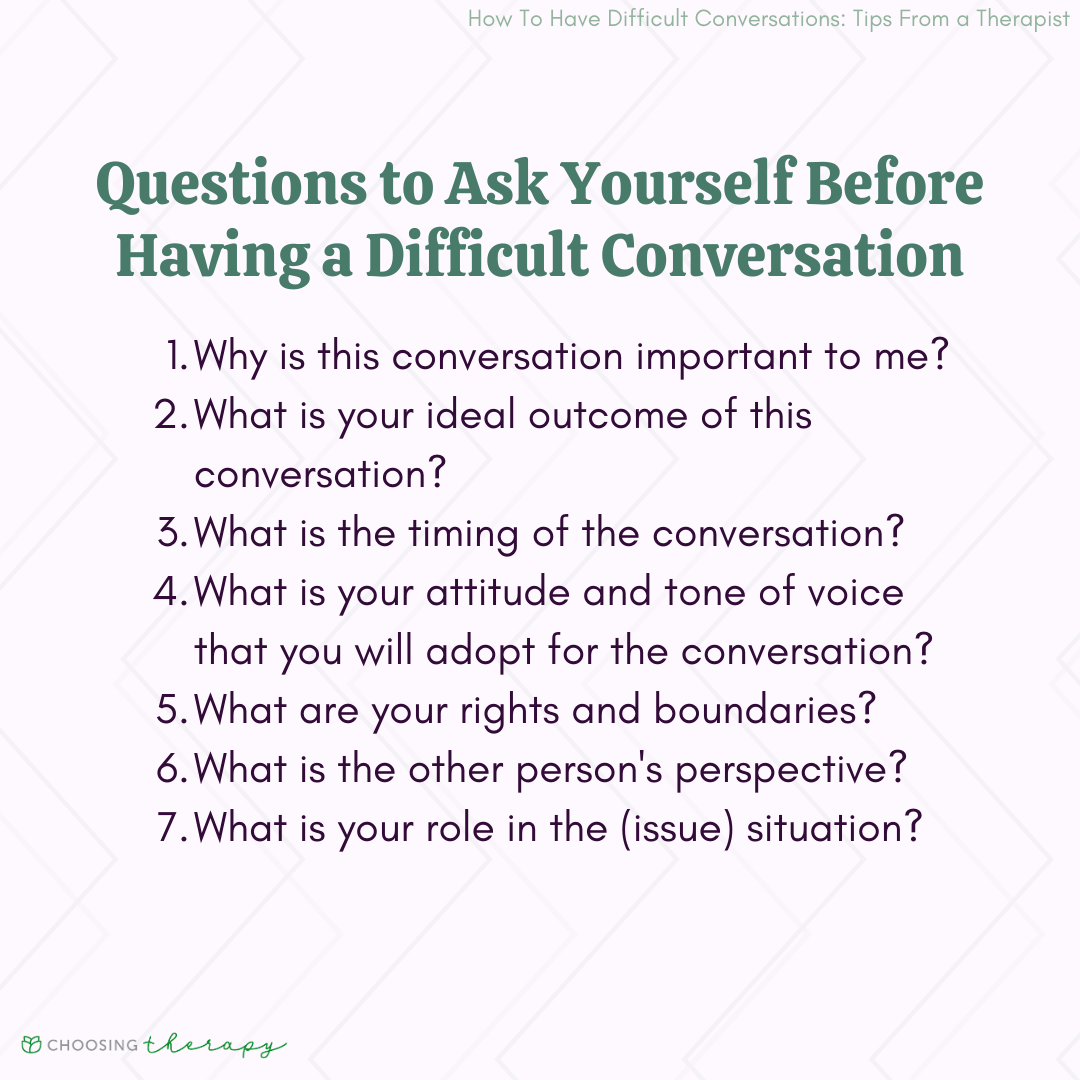
Questions to ask yourself before having a difficult conversation include:
- Why is this conversation important to me? Explore why you feel so strongly about having this conversation and what you are willing to sacrifice to do so.
- What is your ideal outcome of this conversation? Decide what you want from the conversation and what you hope to achieve. Determining your ideal outcome will enable you to remain on track, and it will help you to avoid getting sidetracked in an emotional, reactive manner.
- What is the timing of the conversation? Think carefully about the right time to initiate the conversation, taking into account the most appropriate time for both parties. Consider whether the person is in a receptive or defensive state of mind and whether they are likely to be able to hear and process what you are saying.
- What is your attitude and tone of voice that you will adopt for the conversation? Aim to remain calm and composed, listening to the other person without interrupting them or becoming impatient. Think about how you will phrase your words so that they are clear and concise and convey your message in a respectful and non-judgmental way.
- What are your rights and boundaries? Be aware of setting your personal boundaries and decide what you are and are not willing to accept. Clarify your rights and what you expect from the conversation – this will allow you to be more assertive and confident.
- What is the other person’s perspective? It is essential to be aware of the other person’s perspective while addressing difficult subjects. Try to understand their feelings and point of view, even if you disagree with them.
- What is your role in the (issue) situation? It is crucial to understand your role in the situation and how your actions or words may have contributed to the problem. Taking responsibility for your part in the situation can help to reduce the tension and promote a more positive outcome.
How Do I Begin?
So many people feel stuck with how to begin a difficult conversation, which can lead the discussion to get off track before it even begins. Starting a difficult conversation is not easy, but there are specific words you can use to make the conversation less awkward and more constructive. These words can help you set the tone and prepare the other person for what’s to come.
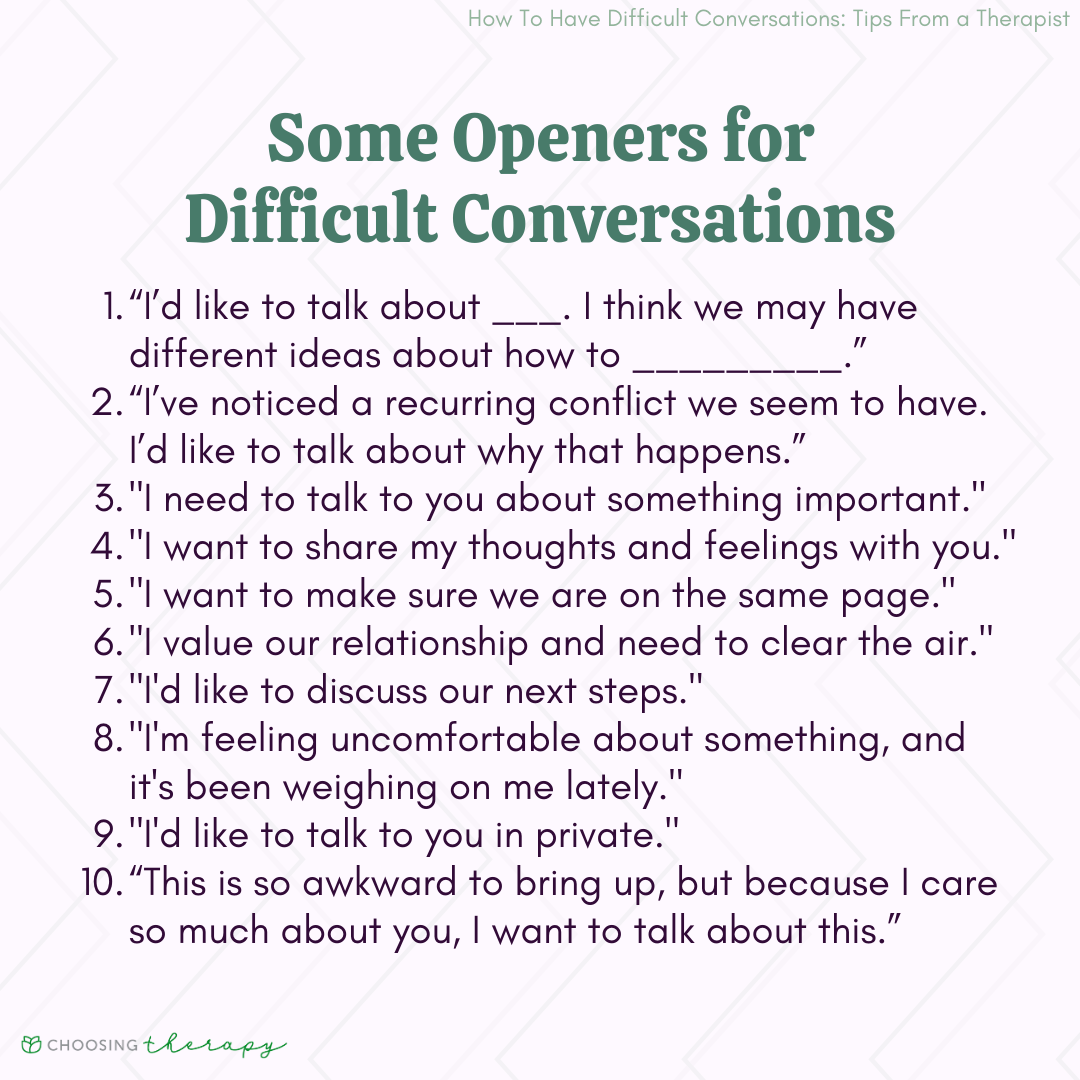
Some openers for difficult conversations include:
- “I’d like to talk about _____________. I think we may have different ideas about how to ________________.”
- “I’ve noticed a recurring conversation (conflict, disagreement, problem) we seem to have. I’d like to talk about why that happens.”
- “I need to talk to you about something important.”
- “I want to share my thoughts and feelings with you.”
- “I want to make sure we are on the same page.”
- “I value our relationship and need to clear the air.”
- “I’d like to discuss our next steps.”
- “I’m feeling uncomfortable about something, and it’s been weighing on me lately.”
- “I’d like to talk to you in private.”
- “This is so awkward to bring up, but because I care so much about you, I want to talk about this.”
Improve Communication with Your Partner in Therapy.
BetterHelp has a large network of licensed therapists worldwide who provide convenient and affordable online therapy. Take a brief assessment and get matched with a therapist who fits your needs in as little as 48 hours. Insurance options may be available for eligible members.* *Insurance availability and coverage may vary by state, plan, provider network, and therapist availability.
10 Tips for Having a Difficult Conversation
Navigating tricky discussions can be nerve-wracking. However, avoiding having these conversations can lead to even bigger problems down the line. Therefore, it is important to be equipped with the necessary tools to have these difficult conversations productively and respectfully. During the conversation, remember why you feel this talk is so important and why you initiated it in the first place.
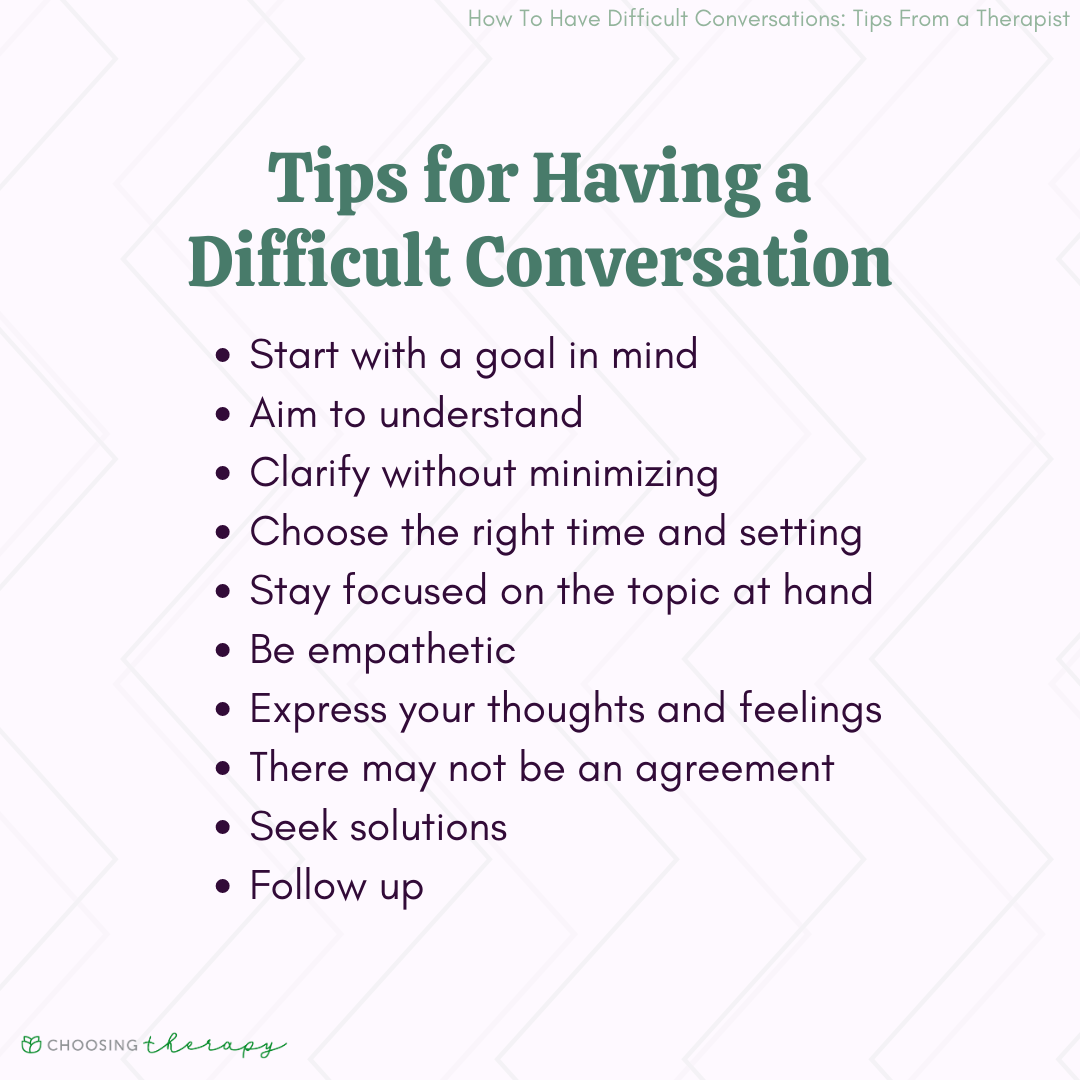
Here are ten tips for having a difficult conversation:
1. Start With a Goal in Mind
Going into a difficult conversation without a goal can make it even more challenging. A clear objective can help you stay focused, save time and effort, reduce stress and anxiety, improve communication, and promote mutual understanding.
2. Aim to Understand
Approaching a difficult conversation to understand the other person’s perspective is essential. Doing so promotes mutual respect, empathy, and problem-solving while reducing defensiveness and preventing misunderstandings. It is critical to understand each other’s sides and clear up misunderstandings around intentions before the conversation escalates.
3. Clarify Without Minimizing
Clarifying another person’s perspective makes them feel valued. To avoid minimizing the person during the conversation, you’ll need effective communication skills and a willingness to suspend your beliefs and be open to other viewpoints. It is important to ask open-ended questions, acknowledge the other person’s perspective, practice active listening, and avoid judgment or defensiveness
4. Choose the Right Time and Setting
Timing is everything when it comes to difficult conversations. Find a time and setting conducive to a calm and focused discussion. Avoid having these difficult conversations in public places or when one or both parties are busy or distracted. If possible, schedule a time to talk in advance so that both parties can prepare and come into the conversation with clear heads.
5. Stay Focused on the Topic at Hand
Stay focused on the issue and avoid taking the conversation in different directions. When emotions are high, it can be easy to bring up past wrongs or unrelated issues, but this only distracts from the main problem. Create a structured conversation and keep it centered on the current issue, and avoid attacking the other person’s character or personality.
6. Be Empathetic
Empathy is perhaps the most important relational skill as it puts you in somebody else’s shoes and reflects how they are feeling in a given situation. Listening empathically, especially during difficult conversations, allows you to relate to and understand their perspective, position, and feelings. We don’t need to have the exact same experience to empathize with somebody else. As human beings, we all experience similar feelings of joy, sadness, loss, love, fear, loneliness, pride, shame, guilt, relief, and elation. If we listen in a way that allows us to relate to that common feeling or human experience, we can improve our connection and shared understanding with others.
7. Express Your Thoughts and Feelings
Express your own thoughts and feelings constructively by using assertive communication strategies that allow you to communicate in a way that is honest, direct, and clear, demonstrating respect for yourself and others. Use “I” statements and avoid blaming or attacking the other person. For example, instead of saying, “You always do this,” say, “I feel hurt when this happens.” By expressing your feelings, you can help the other person understand your perspective, leading to a more understanding and productive conversation.
8. There May Not Be an Agreement
Recognize that you don’t need the other person to agree with you. That’s okay. It may only be necessary to share your opinion in a neutral, well-reasoned way. Realize that they may need to consider what you are saying later but aren’t ready for the conversation now.
9. Seek Solutions
The goal of having a difficult conversation should ultimately be to find a solution that both parties can agree on. Brainstorm together to find ways to resolve the issue at hand, and try to find common ground. Even if you can’t completely agree, finding a compromise or middle ground can be a step in the right direction.
10. Follow Up
After the conversation, it’s essential to follow up to make sure that both parties are following through on their agreed-upon solutions. This shows you are committed to finding a solution and value the relationship.
What to Avoid in Difficult Conversations
Having difficult conversations is a part of life, and sometimes they don’t go as planned. When you find yourself in a conversational stalemate or if the conversation becomes more emotionally charged than expected, remember to take a pause, acknowledge the situation, validate the other person’s feelings, focus on the problem and not the person, offer solutions, and know when to end the conversation.
Some major pitfalls people encounter when having a difficult conversation include stonewalling, silent treatment, and triangulation. By identifying triggers, actively listening, avoiding defensiveness, taking breaks, and using “I” statements, we can minimize the likelihood of stonewalling during difficult conversations.
What to Do After a Difficult Conversation
Having difficult conversations can leave us feeling emotionally exhausted, causing anxiety and stress and wondering what we should do next. As difficult conversations can be hard to handle regardless of the outcome, take time to reflect, acknowledge your emotions, get support, and move forward positively. Remember that it’s not about being perfect but learning and growing from our experiences.
When to Seek Professional Help
Therapy can be an incredibly helpful tool for someone trying to have a difficult conversation. Through therapy, we can clarify our thoughts and feelings, build confidence, master communication skills, practice empathy, and gain insight. If you’re struggling with having a difficult conversation, consider seeking the help of a trained therapist to guide you through the process.
It’s a good idea to seek individual therapy when dealing with conflict aversion or other struggles. With a therapist’s support, you can approach the conversation with greater clarity, confidence, and compassion. There are many options for seeking therapy, including online therapy options. You can also locate a therapist through an online therapist directory.
Some therapeutic methods that can help foster an agreement include:
- Marriage & Couples Counseling: Marriage and couples counseling can be an effective tool for managing difficult conversations. It provides a safe and supportive environment where partners can learn to communicate effectively, understand one another’s perspectives, manage their emotions, and work towards a solution to their issues.
- Family Therapy: Because family members are typically the people that we have the closest relationships with, conflicts are inevitable. Family therapy aims to reduce distress in the family system and help family members work together to manage inevitable challenges.
- Interpersonal Therapy: Interpersonal therapy is a time-limited and structured approach to therapy that centers on resolving interpersonal conflict. It is often used for people struggling with depression and anxiety.
- The Gottman Method: The Gottman Method teaches couples how to make small, positive changes in dealing with and dialogue about problems to prevent further relationship erosion. Having difficult conversations becomes an opportunity to build quality connections.
- Imago Therapy: The goal of Imago Relationship Therapy is to help couples heal old childhood wounds by recognizing and interrupting old patterns and then developing healthier ones. Imago therapy can be helpful when couples are struggling with difficult conversations.
Are communication issues hurting your relationship?
You can develop better communication skills and improve your relationship! OurRitual is a new, hybrid approach to couples therapy that includes weekly expert sessions in addition to self-guided work. OurRitual starts at just $36 per week. Get 20% off your first month with code: choosingtherapy20
In My Experience
In my experience, when clients are willing to develop more empathy and compassion for themselves and others, it enhances their willingness to learn how to have difficult conversations. Compassion is an important factor that allows us to welcome true prosperity. How much money we have, our titles and our achievements don’t define our worth; it’s our ability to love ourselves and others that defines us and gives us a feeling of self-worth. Love is the currency of life. When our heart is full of loving compassion, financial reward is a natural by-product.4
Practice, patience, and perseverance are essential to difficult conversations, and with time, it can become easier to navigate these challenging situations. By following these ten tips on how to have difficult conversations, you can improve your communication skills and build stronger relationships with those around you.

How To Have Difficult Conversations Infographics
ChoosingTherapy.com strives to provide our readers with mental health content that is accurate and actionable. We have high standards for what can be cited within our articles. Acceptable sources include government agencies, universities and colleges, scholarly journals, industry and professional associations, and other high-integrity sources of mental health journalism. Learn more by reviewing our full editorial policy.
-
V. J. Grant, V.J., T. Robinson, T. Catena, H., Eppich, W. & Cheng, A. (2018) Difficult debriefing situations: A toolbox for simulation educators. Medical Teacher 40:7, 703-712.
-
Overton, A.R. & Lowry, A.C. (2013). Conflict Management: Difficult Conversations with Difficult People. Clin Colon Rectal Surg 26: 259-264.
-
Prober, C.G., Grousbeck, H.I., Meehan, W.F. (June 2022). Managing Difficult Conversations: An Essential Communication Skill for All Professionals and Leaders. Academic Medicine, 97(7): 973-976(4).
-
Marter, J. The Financial Mindset Fix: A Mental Fitness Program for an Abundant Life. Sounds True Publishing, 2021.

Your Voice Matters
Can't find what you're looking for?
Request an article! Tell ChoosingTherapy.com’s editorial team what questions you have about mental health, emotional wellness, relationships, and parenting. Our licensed therapists are just waiting to cover new topics you care about!
Leave your feedback for our editors.
Share your feedback on this article with our editors. If there’s something we missed or something we could improve on, we’d love to hear it.
Our writers and editors love compliments, too. :)
Additional Resources
To help our readers take the next step in their mental health journey, ChoosingTherapy.com has partnered with leaders in mental health and wellness. ChoosingTherapy.com is compensated for marketing by the companies included below.
OurRitual – OurRitual combines expert-led sessions with science-backed digital exercises to improve your relationship on your terms. OurRitual starts at just $36 per week. Get 20% off your first month with code: choosingtherapy20 Visit OurRitual
BetterHelp (Online Therapy) – Relationships aren’t easy – a licensed therapist can help. Live sessions can be done via phone, video, or live-chat. Plus, you can message your therapist whenever you want. BetterHelp starts at $65 per week and is FSA/HSA eligible by most providers. Visit BetterHelp

Best Online Marriage & Couples Therapy Options
Marriage and couples therapy can be helpful and a worthwhile investment for couples who want to seek help with their relationship. Which online platform will work best for you will depend on what issues you want to work on, what your goals are for your relationship, the cost, and if it’s available in your state.
Best Online Therapy Services
There are a number of factors to consider when trying to determine which online therapy platform is going to be the best fit for you. It’s important to be mindful of what each platform costs, the services they provide you with, their providers’ training and level of expertise, and several other important criteria.
